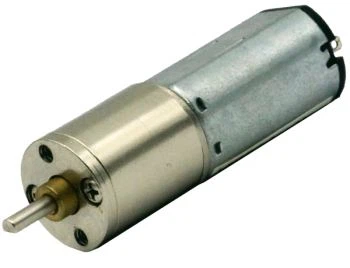
A Quick Look at Gearboxes
A gearbox acts as a core mechanical transmission component widely used in motor-driven rotating equipment. Combined with DC motors, gearboxes transmit rotary motion and boost output torque while adjusting rotational speed.
Most small DC motors run efficiently at high rotational speeds. Developing customized motors to satisfy every unique torque and speed demand brings high development costs. Instead, engineers commonly match standard DC motors with interchangeable gearboxes to achieve target output performance. Designers are able to freely combine motors and reducers to meet diverse project requirements.
The motor input shaft connects to the first gear stage inside the gearbox. Internal gear assemblies adjust speed and torque according to the fixed gear ratio. Fundamentally, gearboxes trade rotational speed for torque: output speed decreases in proportion to the gear ratio, while output torque rises accordingly. The actual mechanical efficiency of the gearbox needs to be taken into account when calculating the final torque output.
The machinery industry has multiple types of gearboxes, including helical gearboxes, bevel gearboxes, right-angle gearboxes, spur gearboxes and planetary gearboxes. Every structural design comes with different characteristics in overall dimension, reduction ratio range, back-drivability and backlash. This article focuses on two mainstream miniature reducer solutions matched with small DC motors: spur gearboxes and planetary gearboxes.

Spur Gearboxes
Spur gears, also known as straight-cut gears, are the most popular gear type for small transmission systems. Straight gear teeth are machined parallel to the axis on circular gear bodies.
When assembled in meshed pairs, spur gears transmit mechanical power via a parallel offset shaft layout. Spur gearboxes regulate equipment speed and amplify torque through engaged gear pairs.
The simple mechanical structure endows spur gearboxes with multiple practical merits: affordable production, stable durability, reliable operation and steady constant-speed output, suitable for general consumer devices and light-duty industrial equipment. Under the same reduction ratio, the axial length of a spur gearbox is shorter than that of an equivalent planetary gearbox.
Spur reducers support optional sintered steel or plastic gear configurations. Designers can choose sleeve bearings or ball bearings, special lubricants for extreme temperature environments, and shortened housings for selected ratios. Multiple types of output shafts are available to facilitate mechanical assembly.
Benefiting from simple tooth profiles, spur gears balance decent precision and convenient manufacturing. The obvious weakness lies in load distribution: force is transmitted through individual contacting teeth, resulting in louder operation noise compared with structures where multiple teeth share loads simultaneously. Spur gearboxes work best under low-to-medium speed intermittent operation. They can also be adopted in high-speed scenarios if noise level is not a primary concern.
Typical application scenarios include smart household devices, beverage dispensers, vending machines and small actuators, where stable light-load transmission and cost advantages are prioritized.

Planetary Gearboxes
A planetary gearbox, also called an epicyclic gearbox, consists of three core components: a central sun gear, surrounding planet gears and an outer ring gear with internal teeth. Planet gears are installed on a shared planet carrier.
This special structural design evenly distributes input loads among several planet gears rather than concentrating pressure on single tooth contact points. This advantage allows planetary gearboxes to deliver high torque within compact cylindrical space, making them widely applied in robotics, 3D printing, medical instruments and continuous-running automation equipment.
Planetary gearbox design focuses on long service life, mechanical precision and stable performance. Various mounting solutions such as flange mounting are supported. The high-speed rotation of the driving motor turns the central sun gear, which drives the surrounding planet gears. The planet carrier outputs reduced speed and amplified torque. Single-stage planetary gearboxes can achieve high mechanical efficiency.
Multi-stage planetary structures support a wide range of reduction ratios. The first stage can adopt plastic gears to reduce noise during long-time continuous high-speed operation. Diversified output shaft options meet various customized assembly demands.
Common application fields cover automated processing equipment, intelligent mobility devices, precision healthcare instruments and robotic actuators that demand high torque density, coaxial output and stable continuous working performance.
How to Select Between Spur Gearboxes and Planetary Gearboxes?
Engineers need to evaluate multiple practical constraints before confirming gearbox specifications. When choosing between spur gearboxes and planetary gearboxes, consider these key factors:
Does the equipment need long-duration continuous high-speed operation?
Is back-drivability acceptable or undesirable for your load?
What axial and radial loads must the gearbox withstand?
What backlash level can be tolerated for positioning accuracy?
Can the gearbox fit into the limited installation space of your equipment?
Spur gearboxes are ideal for cost-sensitive, intermittently operated low-load projects. They stand out when short overall length, dependable operation and offset output layout fit the design requirements, while noise control is not a top priority.
Planetary gearboxes are preferred for continuous operation and high-torque-density applications. The coaxial centered output, multi-tooth load sharing and low-backlash characteristics make them perfect for precision automation equipment and robotic systems.
Frequently Asked Questions
1. What is a gearbox?
A gearbox is a transmission assembly that transfers rotary motion and increases output torque through meshed gear sets, commonly matched with DC motors on rotating machinery.
2. How do gearboxes increase torque?
Gearboxes boost torque while lowering rotating speed based on gear ratios. The real output torque equals theoretical torque multiplied by the mechanical efficiency of the reducer.
3. Why equip DC motors with gearboxes?
DC motors reach optimal efficiency at high rotating speeds. Gearboxes allow motors to run within their efficient speed range while providing the exact torque and speed required by end equipment.
4. Main differences between spur gearboxes and planetary gearboxes?
Spur gearboxes adopt parallel offset straight gear structures for economical light-load transmission. Planetary gearboxes use sun-planet-ring epicyclic structures to realize high torque density with coaxial output shafts.
5. When should you choose a spur gearbox?
Select spur gearboxes for intermittent low-load projects focusing on cost control, such as vending equipment and smart home appliances.
6. What are the major strengths of planetary gearboxes?
Planetary gearboxes output large torque in compact dimensions by distributing loads on multiple gear teeth. They feature high efficiency, good precision and long service life for automation and robotic equipment.
7. How to pick a suitable gearbox model?
Evaluate required torque and speed limits, maximum input speed, back-drive features, load capacity, backlash requirements and space restrictions. Customized gear ratios, shaft sizes and materials are available for OEM projects.